
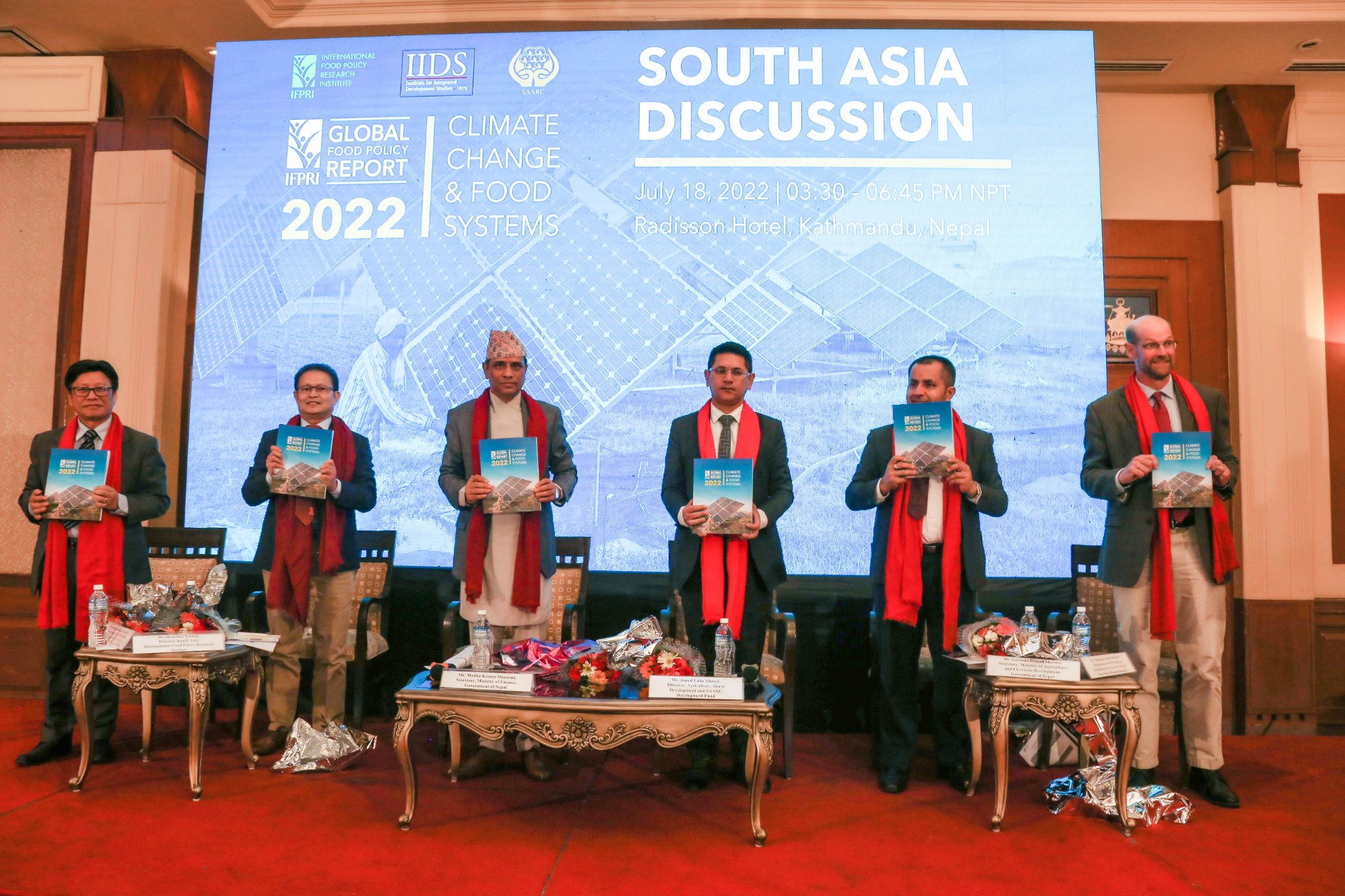
IFPRI-South Asia in collaboration with IIDS and SAARC organized a hybrid launch event of the 2022 Global Food Policy Report in Kathmandu, Nepal on July 18, 2022.
The event was live-streamed on IFPRI South Asia’s Youtube channel.
Investment in food systems transformation can be a game changer for climate change: GFPR Report 2022
July 18, 2022 Kathmandu – Global Food Policy Report 2022 (GFPR 2022) was released in collaboration with International Food Policy Research Institute (IFPRI), Institute for Integrated Development Studies (IIDS) and South Asian Association for Regional Cooperation (SAARC). The chief guest of the program was Mr. Madhu Kumar Marasini, Finance Secretary, Ministry of Finance (MoF), Government of Nepal (GoN), Chair, Dr. Govinda Prasad Sharma, Agriculture Secretary, Ministry of Agriculture and Livestock Development (MoALD, GoN) and Honorable Guest, Mr. Jamal Uddin Ahmed, Director, Agriculture, Rural Development and SAARC Development Fund (SAARC, Kathmandu). The launch event was held among policymakers, civil society organizations and leading think tanks related to the sector.
As opening remarks via. virtual mode, Dr. Swarnim Wagle (Chair, IIDS) started the program and emphasized on the multi-dimensional threats of climate change highlighted in GFPR 2022 report. Overall, major essence in the face of climate change were, relevant research and innovation to be done in changing context of climate change, reorient the financial market structure, and stressed in financial investment. He said that the South Asian region and Nepal should adopt concrete policies in time as climate change is happening rapidly over the world and region, not just limited to a country. He also drew the attention of Mr. Madhu Kumar Marashini, Secretary MoF to the need on proper investments related to climate and food system through the National Treasury. Similarly, he highlighted in other categories, SAARC food bank; safe food system and its education; safe genetically edited food; and South Asian region should be ready to prepare for natural disasters caused by climate change. He said that the policy discussions and recommendations of GFPR 2022 could prove to be a game changer for policymakers in Nepal, South Asia and around the world.
Director of Environment, Production and Technology Division of IFPRI Dr. Channing Arndt said that although there are many promising innovations that can be adopted with climate change, those innovations may be less effective if there is excessive global warming. Finally, he said that there is a need for a stable climate.
South Asia Director of IFPRI, Dr. Shahidur Rashid said that due to the cooling effect of ‘aerosol’ including short-term climate pollutants in South Asia, the increase in average temperature is slightly lower than the global average temperature, but the negative consequences related to health and agriculture are evident. Climate risks in South Asia have been compounded by the effects of COVID-19. The climate change consequences decrease in food production, depletion in natural resources, and decrease in the income associated with it. The impact of climate change has made the region extremely challenging to achieve the zero-hunger goal of the Sustainable Development Goals (SDG 2030).
In the panel discussion related to agriculture and climate change, Chaired by Dr. Biswash Gauchan (Executive Director, IIDS), Ms. Sabnam Shivakoti (Joint Secretary, MoALD), Mr. Ugan Manandhar (FCDO), Mr. Jason Seuc (USAID), Ms. Moushumi Shrestha (Director, Sreenagar Agro) discussed on clean energy; gender dimensions of climate and agriculture, food security issues; technologies and modernization in agriculture; and in the issues of carbon trading.
At the end of the program, the Chief Guest Mr. Madhu Kumar Marasini said that the GFPR 2022 is very important to address the climate change issues, and the flagship report has been released in right time. He said that the current budget of Nepal government has given first priority to agriculture and food security and also to climate risks and its impact on the food system transformation.
Lastly, the Chair of the program Dr. Govinda Prasad Sharma said that climate change has reduced food production, as well as the production of the livestock sector. He also emphasized on the need to adopt a policy implementation, hands-in-hands with the government and the private sector.
Some of the policy recommendations for South Asia in the GFPR 2022 are: to increase investment in agricultural research; promising budget allocation to increase agricultural production; reforms in subsidy of chemical fertilizers; changes in energy policy; water management for irrigation; scientific management of crop production; and includes reform in GoN agricultural assistance.
Click here to watch the event.