
The devastating 2026 Central Nepal flash floods have once again exposed the extent to which the country’s economic infrastructure remains vulnerable to extreme weather and climate. The Government of Nepal’s Rapid Damage and Needs Assessment – conducted only weeks after the flood hit Rasuwa, Nuwakot, Dhading, Gorkha and Chitwan districts …
Subhanga Khanal | August 2026 Here is a moment I cannot stop thinking about: I clicked on an AI song of Freddie Mercury, the late frontman of Queen, singing a track he never recorded, and I absolutely loved it. Then I closed the tab wondering if he would have loved …
Year: 2026 GYAN Fellowship Program The GYAN Fellowship places talented young graduates directly into government school classrooms across Nepal, helping students build strong foundations in Math, Science, and English. Working in teams of three, Fellows support Grades 6–10 in government schools across Kathmandu valley, providing extra teaching and mentorship alongside …
Year: 2026 Transforming Tourism into Nepal’s Primary Growth Pole The Institute for Integrated Development Studies (IIDS) is conducting a major research study on transforming tourism into Nepal’s primary economic growth pole. With Nepal receiving approximately 1.15 million international tourists in 2024 but capturing only USD 40.8 in average daily spending, …
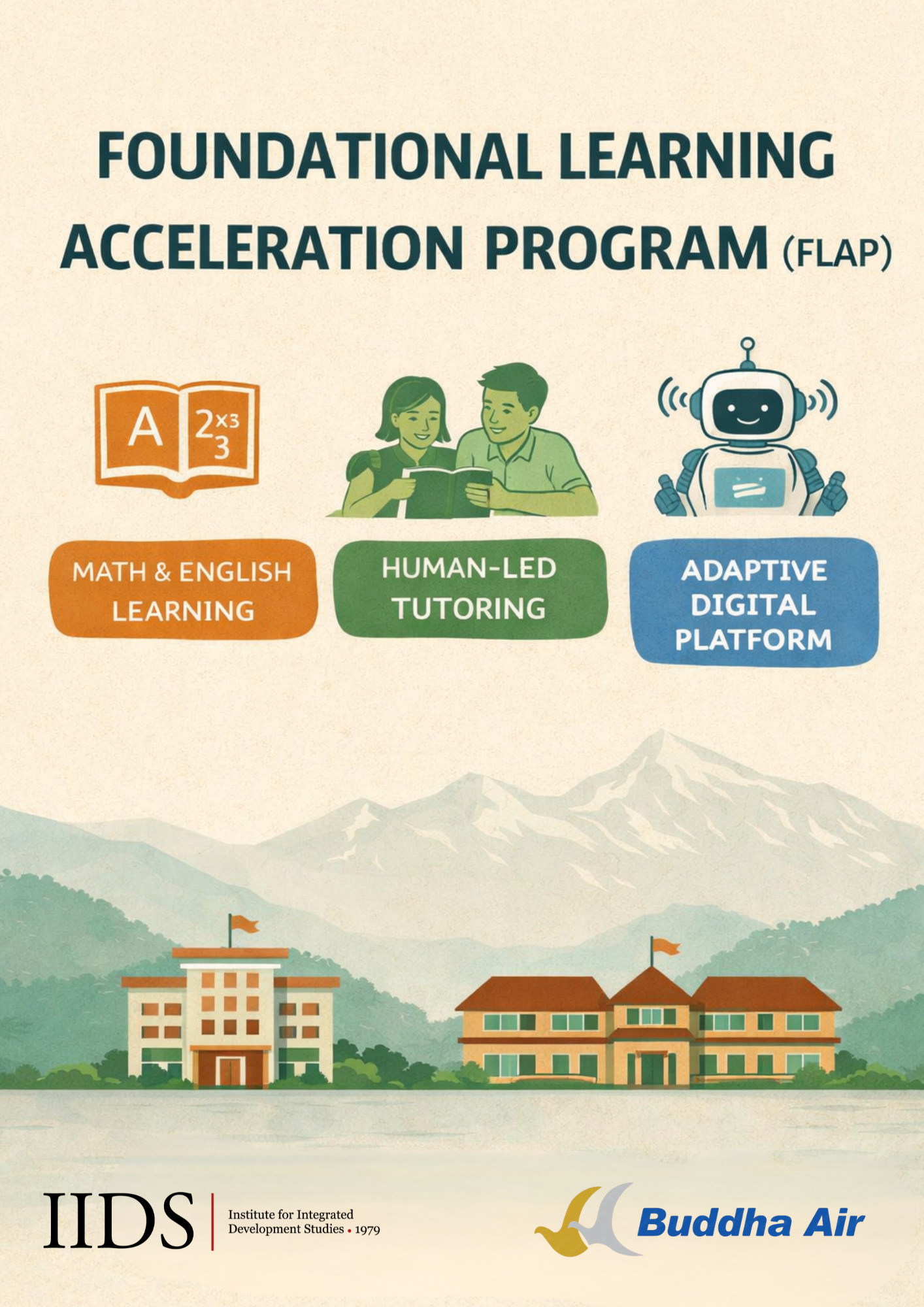
Partners: Buddha Air Pvt. Ltd. (CSR Program) Year: 2026 Foundational Learning Acceleration Program (FLAP) The Foundational Learning Acceleration Program (FLAP) is an evidence-based “learning laboratory” designed to bridge severe primary-level learning gaps in Math and English for Grade 3, 4, and 5 students in Nepal’s public schools. Moving away from …

Partners: ADB Year: March 2026 This study examines how digital trade regulations in Nepal are implemented and experienced by firms in practice. Moving beyond the existence of laws and policies, it focuses on firm-level awareness, compliance challenges, and adaptation strategies across key areas such as data governance, e-commerce, digital payments, …

Partners: IFPRI Year: June 2026 Institute for Integrated Development Studies, in partnership with the International Food Policy Research Institute, is conducting a critical and comprehensive diagnostic study under the Agricultural Transformation and Market Integration (ATMI-II) project. The overall objective is to diagnose key constraints in Nepal’s agricultural trade logistics and …

Partners: IFPRI Year: 2026 Institute for Integrated Development Studies, in partnership with the International Food Policy Research Institute, is implementing an impact evaluation to assess private sector-led digital AgTech B2B platform’s digital and AI-enabled agricultural advisory services including GeoKrishi. The study aims to evaluate the platforms’ effects on farmers’ behavior, …

Partners: IFPRI Year: 2024 This study aims to understand the role of agri-food systems, transport, energy, and climate finance in economic growth, job creation, and greenhouse gas emissions and establish priorities for tailored studies, including agri-food system diagnostics, climate vulnerability assessments, energy transition strategies, and low-carbon transport pathways. This initiative …

Partners: TEWA AND DEPT. OF GENDER STUDIES, T.U. Year: 2024 This study was undertaken by the Institute for Integrated Development Studies (IIDS) for Tewa. Local government is the most accessible level of government to the people, and it is expected to be as deliberative and participatory as possible, especially for …