
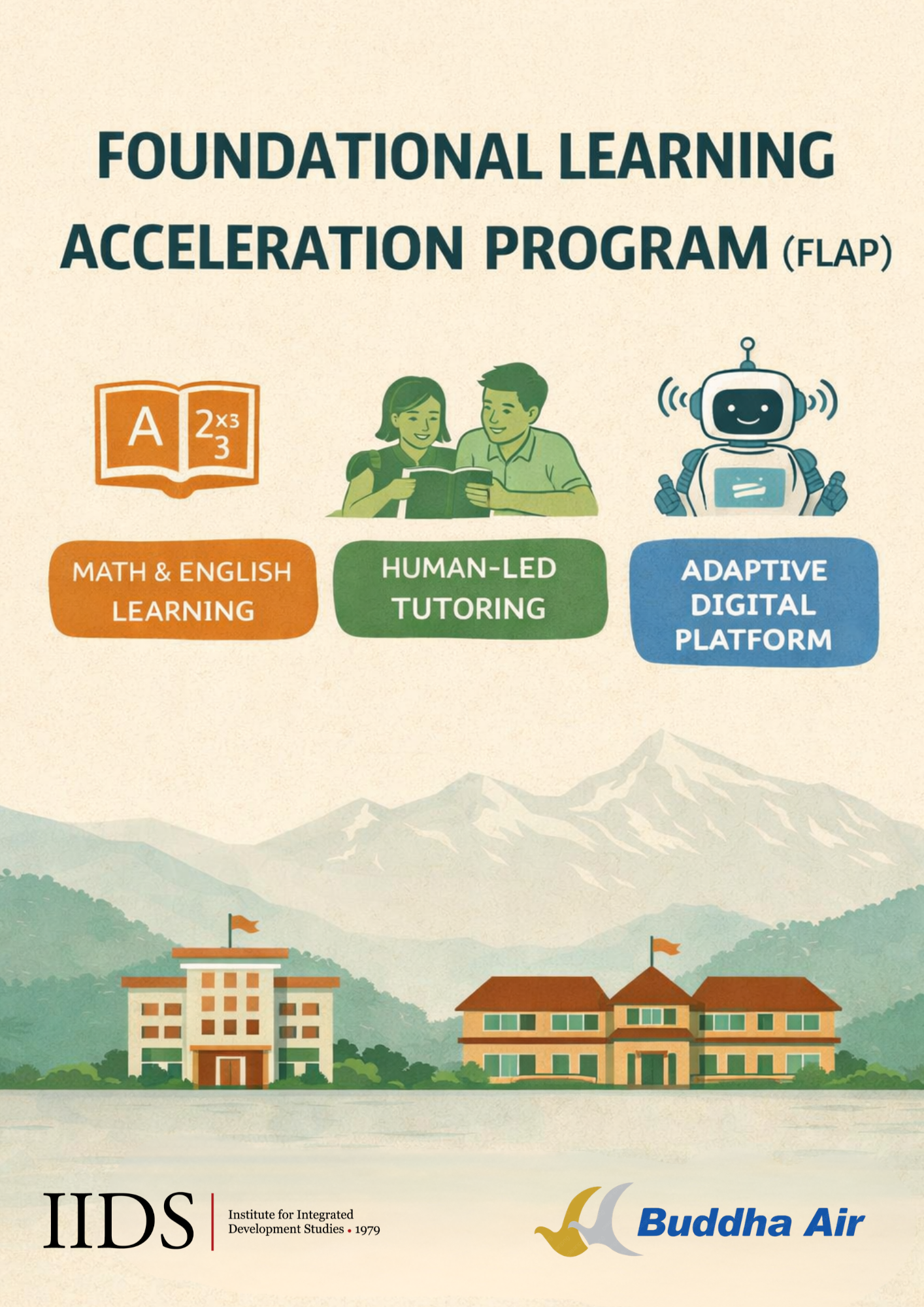
Foundational Learning Acceleration Program (FLAP)
- Partners: Buddha Air Pvt. Ltd. (CSR Program)
- Year: 2026
Foundational Learning Acceleration Program (FLAP)
The Foundational Learning Acceleration Program (FLAP) is an evidence-based “learning laboratory” designed to bridge severe primary-level learning gaps in Math and English for Grade 3, 4, and 5 students in Nepal’s public schools. Moving away from traditional age-based cohorts, the program groups students strictly by their actual learning competency. FLAP integrates intensive human-led tutoring with an adaptive digital platform powered by Generative AI to compile, distill, and deliver custom, bilingual lesson paths. Supported by Buddha Air’s Corporate Social Responsibility (CSR) initiative, this pilot project aims to evaluate and establish a low-cost, highly scalable pedagogical model that secures student mastery of core building blocks before they advance to higher grade levels.
Foundational Learning Acceleration Program (FLAP)
· Partners: Buddha Air Pvt. Ltd. (Corporate Social Responsibility Program)
· Project Duration: January – November 2026
· Lead Researchers & Program Facilitators: Dr. Uttam Sharma (Research Lead, IIDS) and Samyem Tuladhar (Technical Lead & Software Architect)
Project Overview
Despite regular primary school enrollment across Nepal, a silent learning crisis persists: many students reach upper primary grades without mastering foundational literacy and numeracy. Traditional public school environments are frequently constrained by rigid curriculum completion schedules, forcing teachers to move quickly through syllabi and leaving academically weaker students behind in a single-track system.
The Foundational Learning Acceleration Program (FLAP) is a collaborative “learning laboratory” designed to confront this challenge. The project targets students in Grades 3, 4, and 5 to secure their core competencies in Mathematics and English before they enter secondary education, ensuring that their long-term academic trajectories improve exponentially.
The Two-Pillar Solution
FLAP moves beyond standard rote-learning and conventional after-school tuition by utilizing an agile, dual-pillar methodology:
1. Human-Led Targeted Remediation
- Intensive Extended Learning: Students receive one to two hours of daily targeted instruction in school computer labs before or after regular school hours. They are also encouraged to review specific lessons from leading open-source local and international resources, including OLE Nepal, Sikai Chautari, Khan Academy, and Zearn.
- Tutor-Facilitators: Local school teachers and IIDS interns are trained as pedagogical facilitators to guide students through materials, monitor engagement, and step in for direct, one-on-one scaffolded instruction when student progress plateaus are identified.
2. Personalized Digital Platform Powered by Generative AI
- Generative Content Distillation: Instead of directing students to unguided web links, our proprietary platform utilizes Generative AI to prepare customized contents for them. This AI-synthesized material is further refined by our staff to ensure complete pedagogical alignment.
- Adaptive Learning Paths: The platform automatically builds individualized journeys, presenting smart assessments that increase in difficulty as a student succeeds and offering structured, simplified support if they struggle.
- Real-Time Digital Tutoring: The system provides gentle hints and bilingual (English/Nepali) explanations in real-time, acting as a tireless digital assistant that encourages incremental concept mastery.
Implementation, Scalability, and Evaluation
For its pilot phase, FLAP is being deployed in two selected public schools inside the Kathmandu Valley: Saraswati Niketan Secondary School in Teku and Tilingatar Secondary School in Dhapashi.
A core principle of FLAP is its outcome-focused, experimental design: student performance is monitored continuously. If data reveals that a specific pedagogical strategy or prompt is failing to produce learning gains, the team actively pivots to experiment with new methods. Once implementation fidelity is fully established, IIDS plans to coordinate a rigorous impact evaluation to establish FLAP as a low-cost, high-impact, and highly scalable national model for public education reform.
Support and Volunteering
This project is supported by Buddha Air Pvt. Ltd. under its Corporate Social Responsibility (CSR) initiative, which covers tutor honorariums and IIDS-based Research Assistants. Program design, technical coordination, and platform architecture are driven entirely on a voluntary, unpaid basis by IIDS policy researchers and technology specialists.
Explore the platform prototype at: https://iidslabs.org/
