
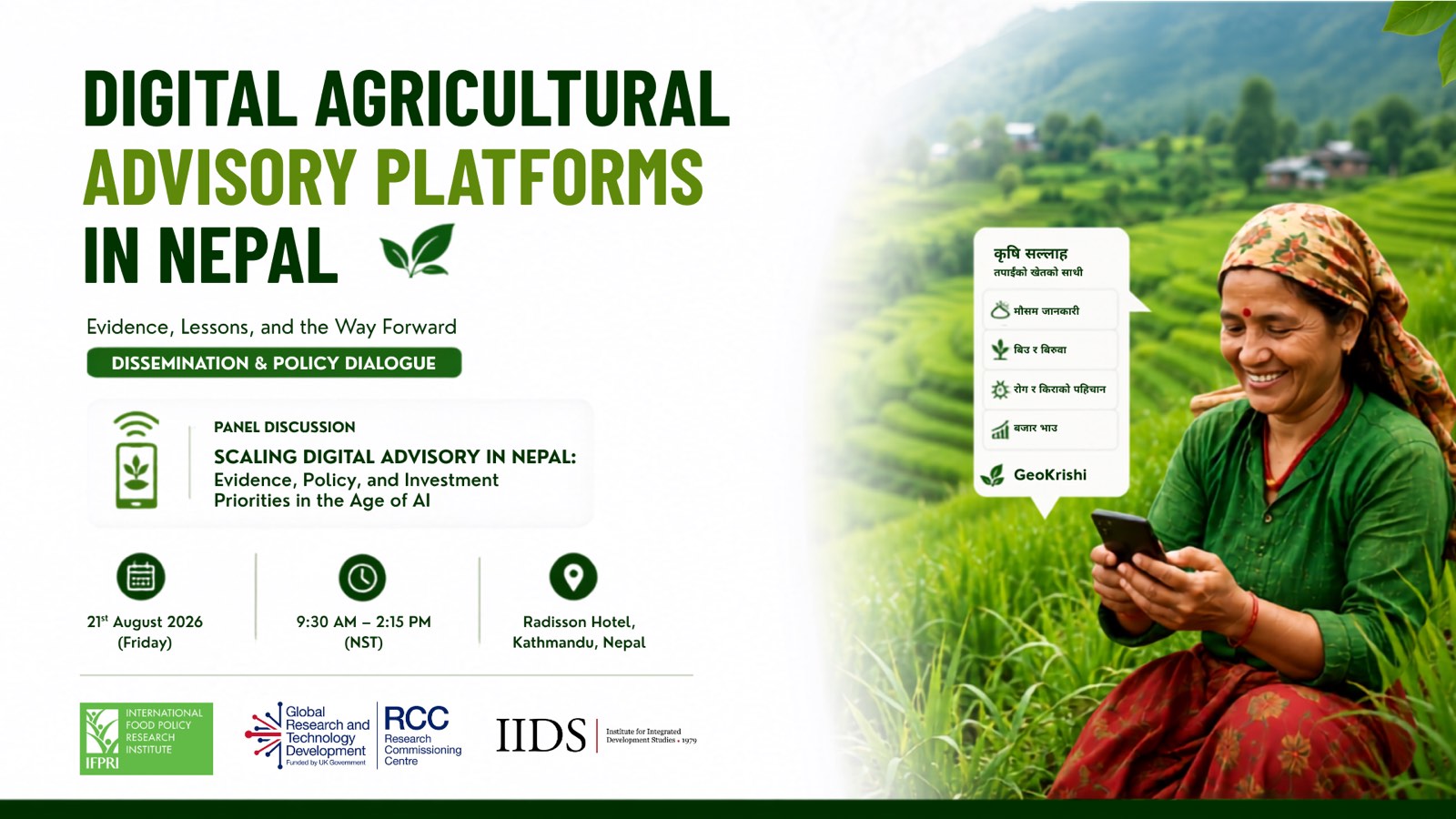
The Institute for Integrated Development Studies (IIDS) hosted a Dissemination and Policy Dialogue on “Digital Agricultural Advisory Platforms in Nepal: Evidence, Lessons, and the Way Forward” on 21 August 2026 at the Radisson Hotel, Kathmandu.
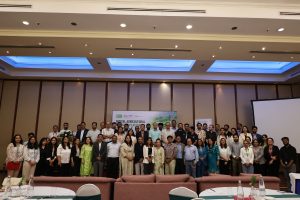
The event brought together representatives from government, the private agritech sector, development partners, and research institutions to discuss the emerging role of digital agricultural advisory services in Nepal. Discussions focused on the evidence on their effectiveness and reach, the policy, regulatory, and financing conditions required for sustainable scaling, and the future of digital advisory tools in Nepal’s agritech ecosystem.
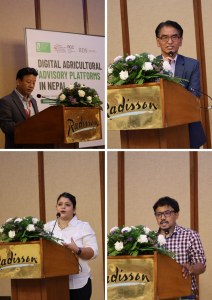
The program featured welcome remarks by Dr. Biswash Gauchan, Executive Chair, IIDS, context-setting and evaluation insights from Ms. Prapti Barooah, Senior Research Analyst, IFPRI, and chief guest remarks by Hon’ble Dr. Devendra Gauchan, Member, National Planning Commission. A case study on GeoKrishi’s approach to digital advisory was presented by Mr. Bobin Thapa, Program Coordinator, GeoKrishi.
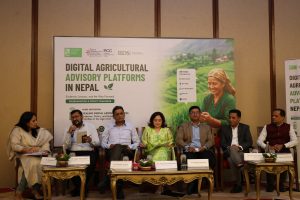
The main panel discussion, moderated by Dr. Muzna Alvi, Research Fellow, IFPRI, explored “Scaling Digital Advisory in Nepal: Evidence, Policy, and Investment Priorities in the age of AI.” The panel brought together representatives from the agribusiness, agritech, research, and development sectors.
The event concluded with audience reflections, closing remarks and a way forward by Dr. Yamuna Ghale, Policy Lead, IIDS.

Event Note:
IFPRI and IIDS present findings from Nepal’s first rigorous evaluation of a private-sector agricultural advisory platform at Kathmandu policy dialogue
Kathmandu, 21 August 2026 — Smallholder farmers in Lumbini Province who actively use GeoKrishi, one of Nepal’s largest digital agricultural advisory platforms, earn significantly more from their harvests than comparable farmers who do not, according to new research presented today at a policy dialogue in Kathmandu. The findings, produced jointly by the International Food Policy Research Institute (IFPRI) and the Institute for Integrated Development Studies (IIDS), also document important limits: benefits are concentrated among better-resourced households, and engagement with the platform consistently depends on the presence of a trained local intermediary rather than the digital application alone.
The event, “Digital Agricultural Advisory Platforms in Nepal: Evidence, Lessons, and the Way Forward,” brought together government, private agritech companies, development partners, and researchers to examine what the evidence says about where digital advisory is working, for whom, and what policy and financing conditions are needed for it to reach further and last longer.
What the research found?
The evaluation surveyed 2,124 farming households across nine municipalities in Dang and Kapilvastu districts between April and May 2026, comparing 1,166 active GeoKrishi users with 958 comparable non-users from the same cooperatives and neighbouring communities.
It is the first study of GeoKrishi, or of any comparable Nepali agritech platform, to use a formal comparison group design capable of producing credible impact estimates.
The results show that GeoKrishi users generate NPR 20,000 to 24,000 more in crop production value per year than comparable non-users, with net returns higher by NPR 18,000 to 21,000. Among households that sell any of their harvest, profit gains reach NPR 47,000 to 55,000 per year. These gains are concentrated in rice and wheat, the region’s primary staple and commercial crops, and come from better input use rather than higher spending: GeoKrishi users are significantly more likely to apply potash, micronutrients, and organic fertiliser, and to adopt more climate-smart farming practices, without a meaningful increase in total farming costs. Users are also five to six percentage points more likely to achieve household food security.
Weather forecasting emerges as the most valued and most consistently used feature, with 89 per cent of users accessing it regularly. Qualitative evidence documents farmers harvesting before predicted storms, delaying planting during erratic rainfall, and timing irrigation around forecast dry spells. Notably, this pathway requires neither high digital literacy nor an active agripreneur to function, making it the platform’s most accessible and robust benefit.
However, the study finds that impacts are not evenly distributed. Benefits are concentrated among households with more land, more household labour, and full dependence on agriculture for income. Smallholder households with less land and fewer family members to act on advice show little to no measurable benefit, pointing to a broader challenge: digital advisory information alone may not be sufficient where farmers lack the complementary inputs, credit, or labour needed to put advice into practice.
The study also finds that about a third of registered users discontinue active use within seven to twelve months of registering, almost always citing the departure of the local agripreneur who introduced them to the platform. Encouragingly, most lapsed users are recoverable: the majority stopped because of a device change or a forgotten login rather than a loss of trust in the platform, suggesting that simple account-recovery improvements could bring many users back.
Policy implications
The research calls on digital advisory platforms to invest in retaining and supporting agripreneurs through formal contracts and reliable pay, rather than concentrating investment on registering new users. For government, the study recommends formalizing coordination mechanism through which District Agriculture Development Offices relay seed distribution, fertiliser subsidy, pest alert, and training notifications through existing cooperative networks. The Banganga Municipality public-private partnership model, under which a formal agreement and a small public subsidy have enabled GeoKrishi to reach approximately 5,500 active users in a single municipality, is identified as a replicable model. For donors and investors, the study recommends requiring platform to report active-user counts rather than registered-user counts in impact and scaling claims, and directing funding toward retaining users rather than acquiring them.
About the research
This evaluation is part of a three-country study funded by the UK Foreign, Commonwealth and Development Office (FCDO) through the Global Research and Technology Development (GRTD) programme, covering digital advisory platforms in Nigeria, Pakistan, and Nepal. The Nepal evaluation was conducted by IFPRI in collaboration with IIDS. The project was commissioned and managed by the GRTD Research Commissioning Centre (RCC), co-led by the International Initiative for Impact Evaluation (3ie) and the University of Birmingham.
About IFPRI
The International Food Policy Research Institute (IFPRI) provides research-based policy solutions to sustainably reduce poverty and end hunger and malnutrition. www.ifpri.org