
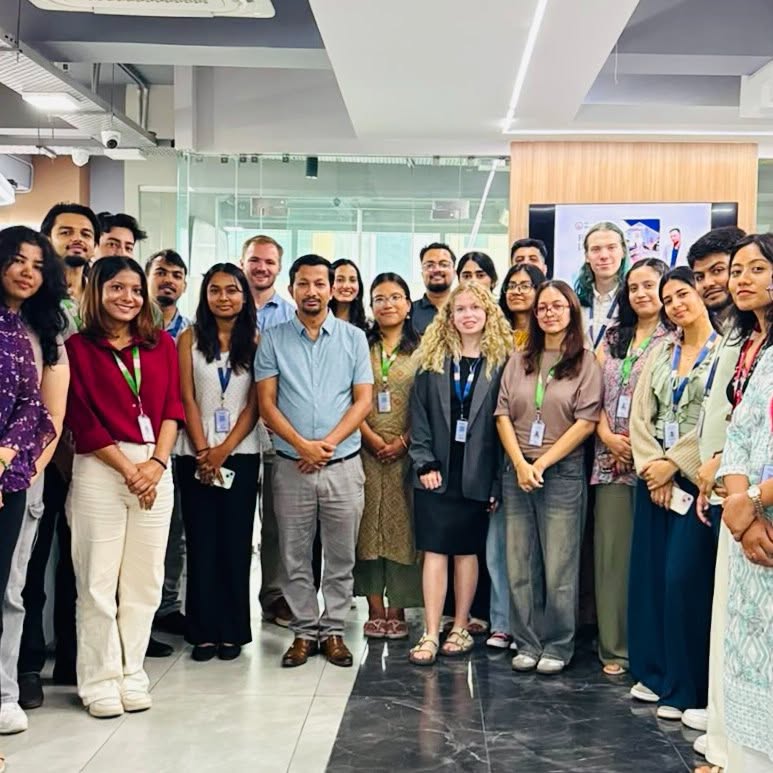
Financial Literacy Session and Sun security office visit report
On 9th July 2026, a team of IIDS interns attended a Financial Literacy training program organized at Sun Securities Pvt. Ltd. (Broker No. 64), one of the member brokerage firms of the Nepal Stock Exchange Limited (NEPSE). The session began at 10:20 AM with 19 attendees present, and was held at the Sun Securities premises as part of the firm’s ongoing weekend and weekday investor training programs, which are designed to help participants at different levels understand how the stock market in Nepal operates, along with the roles of regulators, merchant bankers, and other market departments.
The session was led by Mr. Krishna Giri, Executive Chairman at Sun Securities, along with Mr. Astitwa Sharma, an active capital market investor and trainer. Facilitators reiterated that NEPSE remains the only secondary market operator in Nepal, serving as the primary trading platform through which all listed investors buy and sell shares. The program, titled “Equity Investments for Financial Freedom,” opened with an interactive round where participants shared their backgrounds and investment interests, ranging from technology and entrepreneurship to hydropower and development banks, with returns reported as high as 23% and as low as 8%. One attendee shared that they had been investing through NEPSE for a couple of years with mixed results no major gains, but no significant losses either while another participant, mentioned being new to the stock market, and not yet having opened a broker account. This set the stage for a broader discussion on the share market as an alternative source of income, distinguishing between the two primary approaches to earning in the capital market: trading, which is short-term and driven by technical analysis and price volatility, and investing, which is long-term and guided by fundamental analysis and clearly defined financial goals. Mr. Sharma illustrated this distinction using a gas station analogy the gas station itself represents a long-term investment, while the fluctuating price of the fuel it sells represents short-term trading while Mr. Sharma compared long-term investing to planting a mango tree and waiting patiently for years before it bears fruit. Presenters were emphatic on one rule in particular: technical analysis, used for trading, and fundamental analysis, used for investing, should not be mixed, as the two serve distinct disciplines with different time horizons and objectives. Nabil Bank’s international expansion was cited as a real-world example of long-term investment thinking. The facilitators also noted that Nepal’s current inflation rate stands at around 5.5%, and that developing economies, such as Nepal’s, tend to offer higher potential returns than developed economies, though often with greater volatility.
The session then moved into the basics of fundamental analysis, introducing the top-down approach, which evaluates the broader economy first, followed by the industry, and finally the individual company. Participants discussed emerging opportunities in the technology sector, noting that most of the industry’s workforce falls between the ages of 25 and 30, while also acknowledging brain drain as one of its biggest long-term threats. Traditional sectors such as hydropower were discussed as a relatively easier, well-established investment avenue, though one requiring very high upfront capital, often in the millions of dollars. The music industry was also briefly raised as a potential sector built around intangible assets, worth watching as Nepal’s investment landscape
diversifies. Key valuation concepts were also introduced, including Earnings Per Share (EPS) and the Price-to-Earnings (PE) ratio, with the facilitators explaining the ratio in practical terms: a PE ratio equivalent to a 10-year payback period, for instance, means it would take roughly ten years of earnings to recover the initial investment at current price levels.
A significant portion of the session was dedicated to NEPSE momentum analysis, which Mr. Sharma described as “the hardest way to earn easy money.” Topics covered included Nepal’s T+2 trading settlement cycle, the practice of short selling during negative momentum, and technical tools such as candlestick charts (originally developed by Japanese rice traders), moving averages (simple and exponential), MACD, and RSI. Compounding was framed as a core principle built in two stages: first earning money through sound investment decisions, and then compounding those earnings into further profit over time. Building on this, the discussion turned to long-term wealth-building principles, including the Rule of 72 as a quick method for estimating how compounding grows an investment over time, illustrated through an exercise assuming a 7% economic growth rate that would double a NRs. 10 lakh portfolio roughly every three years. The facilitators also referenced the investing philosophies of George Soros and Warren Buffett, particularly the principle of protecting capital and using stop-loss strategies, before closing the segment with an overview of the bull and bear market cycle noting that bear markets tend to arrive suddenly, with declines of 50–60%, while bull markets typically build more gradually.
Following the session, Mr. Bibek Adhikari, Trading Officer at Sun Securities, led a hands-on demonstration of the account opening and trading process. He walked participants through the documentation required to open a Demat and Trade Management System (TMS) account including citizenship, National ID, passport, and PAN card and explained how the process can now be completed through video KYC. He then introduced the trading tools used by investors in Nepal, including Meroshare for managing Demat holdings, and Bloom, a platform offering market overviews, fundamental and technical analysis, mutual fund analysis, corporate actions, stock calculators, and investment opportunity tracking. Using the ATRAD trading dashboard, he demonstrated how to read live price movements, where red indicates a price decline and green/yellow indicates a rise, and noted that certain shares remain locked by promoters or employees and are not freely tradable, unlike Category A shares, which are. He also highlighted floor sheet analysis, a feature unique to the Nepali market that publicly discloses which broker is buying or selling shares of a given company at what rate, promoting market transparency.
The visit concluded with an office tour, during which the team learned that Sun Securities currently operates with 23 staff members across departments including Customer Service, the Trading Floor, Call Centre, Accounts, Finance, Technology, and Investment Research, with capacity for up to 40. The firm also announced an upcoming Stock SIP (Systematic Investment Plan) offering monthly, quarterly, half-yearly, and yearly investment options, along with an investment workshop featuring veteran investors scheduled for early Shrawan. Throughout the session, presenters expressed optimism about Nepal’s investment landscape, particularly in technology, and described the share market as an unlimited secondary source of income that can complement an individual’s existing
career and expertise, provided investors understand how government policy, inflation, and broader macroeconomic conditions shape market performance. Overall, the session offered valuable, practical insight into how everyday investors in Nepal can enter and navigate the stock market, and the team greatly appreciated the time, expertise, and hospitality extended by the Sun Securities staff throughout the visit.
Prepared by: Rukesh Paudel and Shriju Thapa, Juior research Assistant at IIDS