
Green Growth for Nepal: Turning Climate Targets into Economic Triumphs
A landmark IIDS-IFPRI study reveals that implementing Nepal’s NDC 3.0 climate targets is not an economic burden—it is a blueprint for job creation, poverty alleviation, and resilient growth.
How does a country responsible for just 0.1 percent of global greenhouse gas emissions chart a path toward a resilient, low-carbon future? For Nepal, the answer may lie not merely in climate action, but in transforming environmental commitments into a bold strategy for national economic growth.
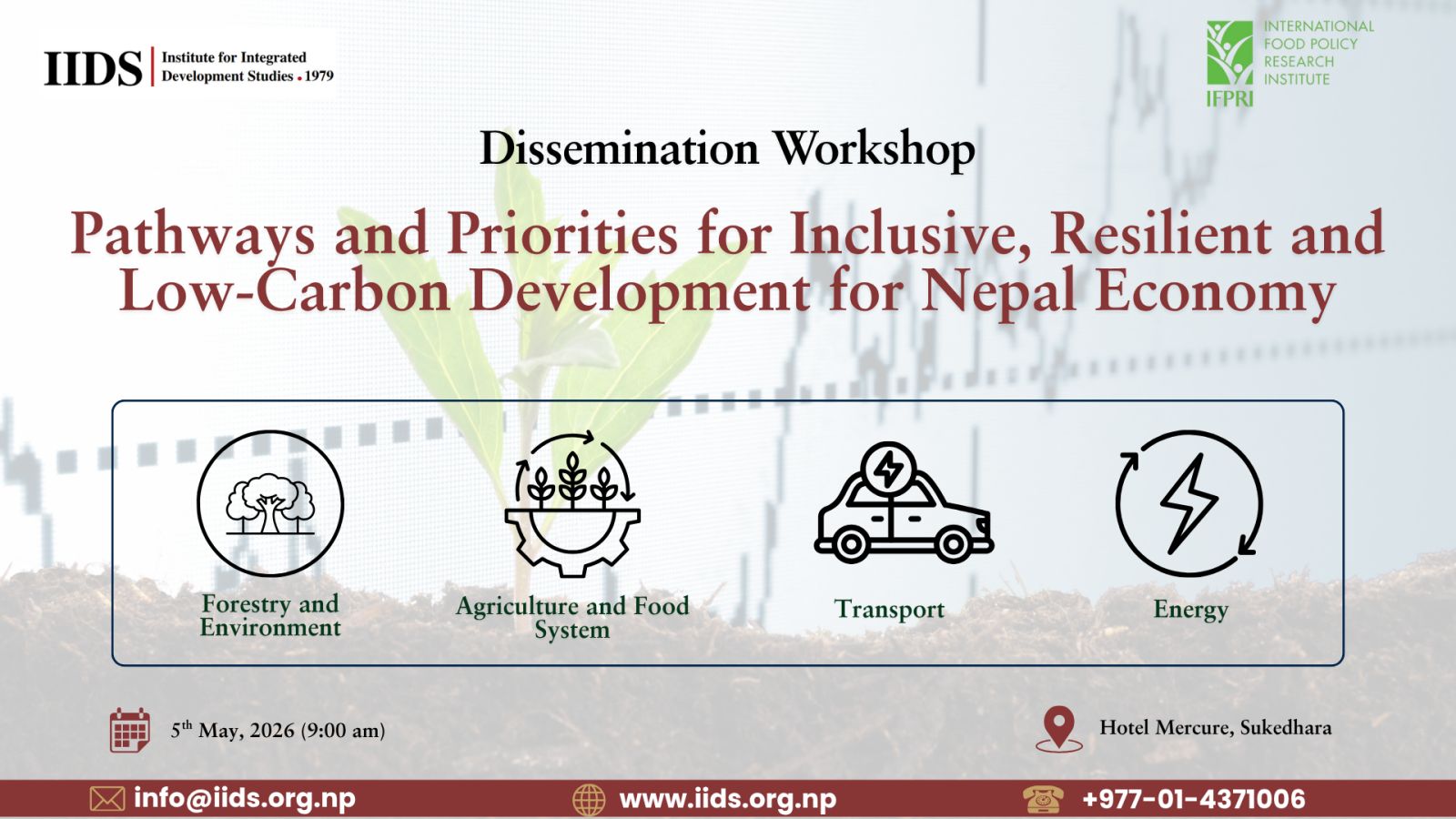
The Institute for Integrated Development Studies (IIDS), in collaboration with the International Food Policy Research Institute (IFPRI), organized a high-level dissemination workshop in Kathmandu on “Pathways and Priorities for Inclusive, Resilient, Low-Carbon Development and Climate Finance.” Supported by the UAE and the Ford Foundation and aligned with the UAE Declaration on Sustainable Agriculture, Resilient Food Systems, and Climate Action (COP28), the event brought together policymakers, researchers, development partners, and government officials to discuss how Nepal’s climate ambitions under Nationally Determined Contributions (NDC 3.0) can shape the country’s economic future.

Representatives from the National Planning Commission, National Statistics Office, Ministry of Finance, Ministry of Energy, Water Resources and Irrigation, Ministry of Forest and Environment, Ministry of Agriculture and Livestock Development, and Ministry of Physical Infrastructure and Transport participated in discussions focused on advancing Nepal’s climate-resilient and low-carbon development agenda through evidence-based planning and policy dialogue.

This study under the CGIAR initiative Future Food Systems, which challenged the conventional perception that climate commitments are an economic burden. Instead, the findings suggest that implementing Nepal’s NDC 3.0 could significantly expand the economy, create jobs, and reduce poverty.
To assess the real-world implications of climate action, researchers employed IFPRI’s dynamic Computable General Equilibrium (CGE) Model, calibrated to Nepal’s 2022 Social Accounting Matrix (SAM). The model analyzed interactions across 80 economic sectors under two contrasting scenarios: a Business-as-Usual (BAU) trajectory and an accelerated NDC 3.0 implementation pathway through 2035.
The results were striking.
In the energy sector, scaling renewable energy—particularly hydropower and solar—to 28.5 GW by 2035 could make Nepal’s economy 2.2 percent larger than the BAU scenario, generate more than 82,000 jobs, and lift over 36,000 people out of poverty. Researchers noted that welfare gains from this transition would be especially significant for lower-income households.
In the transport sector, a projected 20 percent shift to electric vehicles (EVs) could expand the economy by 1.4 percent, create around 10,000 jobs, and reduce poverty for approximately 36,000 people. Nepal’s rapidly growing EV market—among the fastest globally—signals strong momentum toward cleaner mobility.
Meanwhile, climate-smart agriculture, a sector employing nearly 60 percent of Nepal’s workforce and contributing 24.1 percent to GDP, emerged as a cornerstone of green growth. With targeted interventions such as 4 percent annual productivity growth, reduced post-harvest losses, and improved livestock systems, agricultural GDP growth could increase by 2.85 percent annually, generate approximately 100,000 green jobs, and help lift 100,000 people out of poverty.
Yet the path to a low-carbon economy is not without major obstacles.
Foremost among these is financing. Nepal faces an estimated USD 115 billion investment gap, while the total cost of implementing NDC 3.0 stands at USD 73.74 billion, approximately 85 percent of which remains conditional on international support. Questions around mobilizing adequate climate finance, attracting private investment, and ensuring long-term fiscal sustainability featured prominently in workshop discussions.
The transition also raises structural concerns. As Nepal shifts rapidly toward electric mobility, the government may face declining revenues from petroleum taxes, a historically significant source of public income. Infrastructure constraints—including grid instability, seasonal electricity shortages during dry months, and inadequate EV charging networks—pose additional barriers to implementation.
Institutional capacity gaps further complicate the picture. Participants highlighted shortages in public technical institutions, including staffing deficits in agricultural research agencies such as the Nepal Agricultural Research Council (NARC), which may undermine implementation capacity at the local level. Researchers also acknowledged that the current modelling framework does not yet incorporate the long-term ecological and lifecycle costs associated with EV battery disposal, an issue slated for future research.
The workshop also moved beyond data to questions of implementation, equity, and governance.
Delivering the keynote remarks, Hon. Dr. Devendra Gauchan, Member of the National Planning Commission, emphasized the importance of soil health in shaping nutrition and public wellbeing. He argued that prioritizing a 15 percent reduction in post-harvest losses through better handling and storage systems could generate greater economic returns than focusing exclusively on increasing raw agricultural output.
Similarly, Dr. Yamuna Ghale, Senior Research Fellow at IIDS, stressed that agriculture is fundamentally tied to national sovereignty and called for a systems approach that recognizes women as primary farm managers. She raised concerns over implementation practices that undermine local integrity, questioning the growing reliance on imported grafted apple saplings while products continue to be marketed as “local organic.”
Highlighting the importance of local implementation, Hari Prasad Sharma, Joint Secretary at the Ministry of Water Supply, emphasized that Nepal’s clean energy transition must begin at the municipal level. He underscored the urgency of promoting clean cooking technologies, noting that nearly 64 percent of Nepali households still rely on firewood for cooking.
Open-floor discussions generated robust debate among bankers, environmental experts, researchers, and civil society representatives regarding equity and financing. Participants raised concerns that Nepal’s EV transition remains heavily concentrated among private luxury vehicles rather than accessible public transportation systems. Several attendees advocated for decentralized and small-scale transport solutions, including electric ropeways—to improve market access for remote rural producers.

Representatives from Nepal Infrastructure Bank (NIFRA) stressed that mobilizing private capital for green agriculture and low-carbon infrastructure will require stronger Public-Private Partnership (PPP) frameworks, blended finance mechanisms, and government-backed credit guarantees to reduce investment risks.
Despite challenges, the message emerging from the IIDS-IFPRI workshop was unmistakable: NDC 3.0 is not simply a climate agenda, it is a development strategy.
If implemented strategically, Nepal’s climate commitments could become a catalyst for inclusive economic transformation, generating employment, reducing poverty, strengthening food systems, and accelerating energy security. But success will depend on whether the country can close financing gaps, strengthen institutions, ensure policy coordination across sectors, and safeguard an equitable transition where vulnerable communities and women are not left behind.
The research team acknowledged limitations in the current analysis, including its focus on three major sectors, assumptions of full target achievement, and the exclusion of EV battery lifecycle impacts. Future iterations of the study are expected to expand sectoral coverage and deepen analysis of environmental trade-offs.
For Nepal, the challenge ahead is clear: turning climate ambition into economic reality.